
'IDF (the Israeli Defence Forces) soldiers, be it a girl or a boy, they may look very cute, but you cannot mess with them.' 'People are serving their country at 95 years of age. That's the greatest example of patriotism.'

An India-Japan joint statement said the two leaders expressed serious concern over the conflict and the unfolding humanitarian crisis in Ukraine.

Biden, the 80-year-old Democrat, made the announcement in a three-minute promotional video that begins with a one-word pitch: Freedom.

The Russian shipyard which upgraded INS Sindhurakshak, on Wedneday said it had installed advanced weaponry, both Indian and foreign systems, to enhance the submarine's "combat capability and safe operation".

While it was a meet and greet encounter between Prime Minister Manmohan Singh and his Pakistani counterpart Yousaf Reza Gilani on Monday evening, no doubt disappointing journalists on both sides, United States President Barack Obama singled out Dr Singh for a warm hug at the dinner South Korean President Lee Myung-bak hosted for leaders attending the second Nuclear Security Summit, reaffirming in a sense their effusive personal relationship.
'This cannot be credibly explained away by referring to a "technical glitch".'
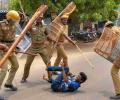
Tamil Nadu Governor R N Ravi stoked a fresh controversy on Thursday, remarking that the anti-Sterlite protests in the state in 2018 had been fuelled by foreign funds and was aimed at hindering progress. His comment instantaneously drew an outcry from the ruling Dravida Munnetra Kazhagam and its allies.
Uncritical acceptance of any major project is undesirable. So also is unbending opposition to it. Constructive criticism of the project could bring about greater safety in design, construction and operation or even lead to abandonment of the project. The scientific and engineering community in the country should play an active role in such criticism instead of remaining mute spectators, leaving the ground to the lay public, says L V Krishnan.

... And it's not just fear of job losses, says Ajit Balakrishnan.
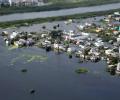
If only you had thought ahead, you would have stocked snacks and biscuits, bread and cake, and vegetables suited for Amma or pondatti to make your favourite bajji and pakoda, observes N Sathiya Moorthy.

A suspected Chinese spy balloon, said to be the size of three buses, was spotted over the United States' airspace, the Pentagon has said, a development that has further strained the already tense bilateral ties as Secretary of State Antony Blinken on Friday abruptly postponed his key visit to Beijing.

The Kundankulam Nuclear Power Plant attained its full generation capacity and became the first nuclear plant in the country to generate 1,000 MW of power on Saturday, its site director R S Sundar said.
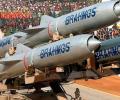
Pakistan has rejected India's action over the March 9 accidental firing of a supersonic BrahMos missile that landed in its territory as "totally unsatisfactory, deficient and inadequate" and reiterated its demand for a joint probe into the incident.

The Australian prime minister also said that he briefed Prime Minister Modi on AUKUS - a trilateral security arrangement between Australia, the UK and the United States that was unveiled in September 2021.
Anirudh Burman, analyst with New Delhi-based PRS Legislative Research, details concerns about India's nuclear power generation

'You have to be a total anti-national bozo to shut down the Nokia plant in Sriperumbudur, which was the first large manufacturing plant for mobile phones in India.' 'Why was the unit shut down? Because of somebody's ego.'

'The lessons learnt from the triple disaster have put Japan's energy future On the right path,' notes Dr Rajaram Panda.

Notwithstanding how the current impasse is solved, at some point in the future, Russia will realise that just as centuries ago it developed the paradigm of securing its heartland's safety through annexing vast buffer zones between itself and the enemy, a more modern security is possible only through friendly relations and sustainable peace, observes Shyam G Menon.

The The Airports Authority of India is likely to procure two counter-drone systems worth Rs 9.9 crore in 2022-23, according to an official document.
United States President Barack Obama on Friday ordered a "comprehensive" safety review of all the nuclear power plants in the country in light of the current situation in Japan where high levels of radiation from quake-crippled reactors are threatening to spew-out disaster.

Russia has informed the United Nations Security Council that Russian buses are ready at crossing points to go to the eastern Ukrainian cities of Kharkiv and Sumy to evacuate Indian students and other foreign nationals who are stranded there, amidst the raging conflict in the East European country.
India on Wednesday said the terror attack on a naval base in Karachi was a cause of serious concern, particularly with regards to the safety of nuclear arsenal in Pakistan, but it does not want to overreact.
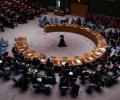
India abstained from a procedural vote taken in the United Nations Security Council to call for a rare special emergency session of the UN General Assembly on Russia's aggression against Ukraine, even as New Delhi welcomed Moscow and Kyiv's decision to hold talks at the Belarus border.
India's nuclear operator has started loading enriched uranium fuel in the first reactor of the Kudankulam Nuclear Power Project after getting the final clearance from the Atomic Energy Regulatory Board (AERB) on Tuesday.
The Kudankulam Nuclear Power Plant suffers from lack of safety measures and is plagued by several other "serious issues". It must not be commissioned till they are resolved, anti-nuclear activists told the Supreme Court on Thursday. Appearing before a bench of Justices K S Radhakrishanan and Deepak Misra, they submitted that the safety measures recommended by the Atomic Energy Regulation Board have not been put in place.

Out of 120 members of the Knesset (Israeli parliament), Netanyahu has the support of 64 members

While Indian Air Force ace pilot Group Captain Abhinandan Varthaman was accorded the Vir Chakra, Army Major Vibhuti Shankar Dhoundiyal, who was killed in the 2019 Pulwama terrorist attack, was accorded the Shaurya Chakra (posthumously) by President Ram Nath Kovind in an investiture ceremony on Monday.
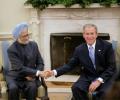
In the mid-1980s, India and the US struggled to arrive at sufficient confidence for Washington to even sell a supercomputer to India for monsoon prospecting. Now, the most sensitive military technologies, data, and intelligence resources are being shared. This would not have happened without that one, big deal that changed the fundamentals of India-US relations, notes Shekhar Gupta.
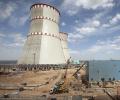
Continued instability in Pakistan could impact safety of its nuclear weapons and materials, a latest US Congressional report has said as it described the sale of two nuclear reactors by China to Pakistan a violation of the NSG guidelines.

'Rani made it very clear when she signed the film that she would shoot only during her daughter's summer vacation so as not to disturb her role as a real life mother.'

The apex court also pulled up the Gujarat government for extending the deadline till July next year for hospitals to rectify the building by-laws violations, and said the "carte blanche" notification was in teeth of its order of December 18 last year and people will continue to die in fire incidents.

'This is about children caring for their parents and helping them with assistance.'
Dr Suresh Moses Lee, who was one of the members of the panel of experts constituted by the Centre to examine the reactors of Koodankulam Nuclear Power Project, talks to rediff.com's Shobha Warrier about the safety aspects of the controversial plant.
Giving a thumbs up to the Koodankulam nuclear power project, former President A P J Abdul Kalam on Sunday said he is "fully satisfied" with the safety measures incorporated in the mega power project.
Prime Minister Manmohan Singh on Friday told a delegation that a high-level committee would address their concerns on safety of the Kudankulam nuclear power project.

Trying to contain the unjustified, yet growing sudden spurt of apprehensions against nuclear energy production in India, experts from radiation safety, nuclear technology and nuclear medicine explained in Mumbai at a seminar how the nuclear power technology in India and the world is 'mature and safe'.
President Francois Hollande's visit to India on Thursday saw a protest against French-assisted Jaitapur nuclear power plant by activists who alleged that proper safety measures had not been adopted in the project to prevent a Fukushima like disaster.
The reactors that exploded at the Fukushima nuclear plant in Japan following the earthquake and tsunami are similar to those at Maharashtra's Tarapur atomic power plant. But does India need to worry?

Taiwan says it detected multiple Chinese aircraft and naval vessels taking part in military drills around the Taiwan Strait on Saturday, in what could be a possible simulated attack against the island.
Not taking any chance of India facing Fukushima-type nuclear disaster, the government is gearing up India's nuclear power plants and other reactors for automatic shutdown, requiring no human intervention, if any earthquakes of the least intensity strikes.
